Inventory shrinkage or should we say the margin loss you didn’t realize you were losing
Inventory shrinkage is one of the most persistent and underestimated challenges for retailers. It erodes profitability and disrupts operations.
At its core, inventory shrinkage is defined as the loss of inventory that occurs when the recorded inventory in your system is higher than the actual inventory physically available. In other words, the numbers in your inventory management system don’t match what’s sitting on your shelves or in your warehousing facilities.
But for many retailers, there’s an even more relatable way to describe it. Inventory shrinkage is “margin loss you didn’t realize you were losing.”
It’s the profit that disappears silently through theft, human error, administrative errors, moving stock around, discounting and inefficiencies — until it shows up as a weaker bottom line.
Understanding what causes inventory shrinkage, how to calculate it, and how to prevent inventory shrinkage is critical for retailers who want to protect profit margins and improve inventory accuracy.
What is inventory shrinkage?
Inventory shrinkage refers to the difference between recorded inventory and physical inventory.
Retailers typically calculate it using this formula:
Inventory Shrinkage = (Recorded Inventory – Actual Inventory) ÷ Recorded Inventory
This gives you the inventory shrinkage rate, usually expressed as a percentage.
For example, if your system says you have $1,000,000 worth of stock but a physical count shows only $950,000, you have $50,000 in lost inventory. That’s a 5% shrinkage rate.
According to the National Retail Federation in America, shrinkage consistently costs retailers billions annually. Yet shrinkage isn’t just about theft as it is deeply embedded in the inventory management process.
Common causes of inventory shrinkage
Understanding the causes of inventory shrinkage helps retailers design effective loss prevention strategies. The most common causes include:
1. Internal theft
Employee theft remains a significant contributor to loss of inventory. Weak inventory control, limited oversight and poor security measures increase risk.
2. External theft
Shoplifting, organised retail crime and ecommerce fraud all fall under external theft. Retailers with disconnected point of sale (POS) systems often struggle to track inventory movement accurately.
3. Administrative errors
Administrative errors include incorrect pricing, duplicate SKUs, data entry mistakes or inaccurate receiving processes. These all create discrepancies between recorded inventory and actual inventory.
4. Supplier errors
Overbilling, short shipments or invoicing discrepancies within the supply chain can inflate recorded inventory.
5. Spoilage and perishable goods
Retailers handling perishable products face additional shrinkage risk. Spoilage, damage and expiry all contribute to shrinkage and impact stock levels.
6. Inefficiencies in warehousing
Poor warehousing practices, misplaced items, or inadequate inventory counts result in inventory inaccuracies and stockouts — even when product technically exists somewhere in the business.
Shrinkage often reflects systemic inefficiencies rather than a single issue.
A broader view of margin erosion
Shrinkage is one dimension of loss. Another critical but overlooked measure is inventory leakage.
Inventory leakage is measured by the portion of inventory value that doesn’t deliver full margin either because it becomes dead stock or is sold at a discount.
When viewed together, dead stock and discounted stock give a clearer picture of inventory inefficiency than either metric alone. Rather than summing percentages, leakage bands align equivalent ranges to benchmark performance.
Inventory leakage benchmark
Inventory leakage is widespread according to a recent Phocas inventory trends in wholesale distribution survey which surveyed many distributors who work in consumer products.
- 39% of distributors experience moderate to high leakage
- 21% don’t know their leakage rate, highlighting a major visibility gap
Here’s how respondents reported their inventory leakage:
0–2% (20%) Minimal obsolescence and little to no reliance on discounting.
2–5% (20%) Dead stock and discounting are present but planned and manageable.
6–10% (26%) Regular discounting and dead stock starting to impact cashflow and margins.
10–20% (9%) Misaligned buying and demand, resulting in sustained margin erosion and excess stock.
>20% (4%) Discounting is the primary clearance mechanism and large amounts of cash tied up.
Don’t know (21%) Lack of inventory visibility represents a significant risk.
Leakage directly impacts cost of goods sold, profit margins and the balance sheet. It’s not always classified as shrinkage, but it has the same result of reducing profitability.
Shrinkage affects far more than stock levels
Profitability
Every dollar of lost inventory reduces gross profit. To recover $50,000 in shrinkage, a retailer operating at a 25% margin must generate $200,000 in additional sales.
Pricing pressure
Retailers often increase pricing to offset shrinkage, potentially hurting customer experience and competitiveness.
Stockouts and lost sales
Inaccurate inventory levels lead to stockouts. When your system says you have product available but you don’t, customers lose trust especially in ecommerce.
Distorted metrics
Shrinkage distorts critical metrics like inventory turnover, shrinkage rate, inventory levels and margin analysis.
Balance Sheet risk
Inflated recorded inventory misrepresents asset value, creating balance sheet inaccuracies.
Strong inventory management reduces both shrinkage and leakage.
An effective inventory management system integrates:
- Point of sale (POS) data
- Ecommerce transactions
- Supply chain updates
- Warehousing activity
- Real-time stock levels
Inventory management software allows retailers to track inventory continuously, reconcile discrepancies faster and automate processes that significantly reduce human error. With better visibility into stock levels and movements, retailers can identify issues earlier and respond before small discrepancies become major losses. Retailers looking to prevent inventory shrinkage should focus on a combination of operational discipline and technology, ensuring that processes are supported by systems designed to improve accuracy and accountability across the business.
Retail shrinkage affects the entire inventory management process, from purchasing to warehousing to the final point of sale transaction.
When retailers gain visibility into
- Inventory shrinkage rate
- Dead stock levels
- Discounting trends
- Supply chain discrepancies
- Cost of goods sold
- Profit margins
They are able to optimize the amount of inventory held, maintain accurate inventory levels, and protect margin at every stage.
The bigger risk is not knowing your stock shrinkage rate
Perhaps the most concerning finding in the Phocas inventory trends in wholesale distribution is that 21% of distributors don’t know their leakage rate.
Lack of inventory visibility is itself a risk. Without accurate metrics, retailers can’t calculate inventory shrinkage properly, track inventory effectively or understand how much margin is being eroded through inefficiencies.



Katrina is a professional writer with a decade of experience in business and tech. She explains how data can work for business people and finance teams without all the tech jargon.
Related blog posts

In 2026, wholesale distributors continue to operate in an environment shaped by ongoing supply chain disruptions and demand fluctuations. The complexity of managing inventory levels has intensified as businesses cope with the economic fall out of the Middle East crisis. Margin pressure is an ongoing issue while trying to meet customer demand across traditional channels and ecommerce.
Read more
Wholesale distributors rely heavily on data to guide inventory management across thousands of SKUs and complex supply chain operations. With variables like gross margin, cost of goods sold (COGS) and inventory turnover, professionals working across a distribution business need to determine what’s relevant to them as well as how they work together.
Read more
Inventory management is a tight-rope balancing act. Ordering too much leaves you with excess stock tying up capital and warehouse space. Ordering too little puts you at risk of running out of stock, leading to stockouts, missed sales and frustrated customers. Inaccurate inventory forecasting means storage fees, excess inventory, waste from unsold goods and operational inefficiencies that eat into profits.
Read more
Inventory days formula is equivalent to the average number of days each item or SKU (stock keeping unit) is in the warehouse.
Read moreBrowse by category
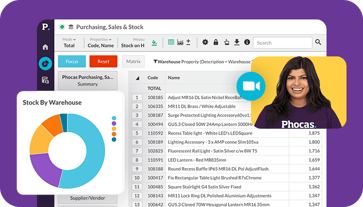
Find out how our platform gives you the visibility you need to get more done.
Get your demo today Analytics
  Financial Statements
  Budgets & Forecasts
  Rebates
  CRM
CRM  Insights